




A decade ago, server architectures were built primarily around CPUs as the main computing resource. Common workloads included databases, web applications, file storage, and basic virtualization. Performance improvements were achieved by increasing processor clock speeds and adding more cores.
Today, however, server workloads have changed significantly. They are now highly parallel, involve repetitive operations, process massive volumes of data (including real-time streams), and are sensitive to latency and bandwidth.
This transformation has led to the widespread adoption of heterogeneous computing. In modern systems, CPUs and GPUs serve distinct roles: the CPU manages control and orchestration, while GPUs handle the bulk of computational tasks in GPU dedicated servers.
Why CPUs Alone Are No Longer Sufficient
CPUs are designed for general-purpose computing. They excel at handling control logic, complex decision-making, and sequential operations. However, this flexibility becomes a limitation for modern workloads.
Most current server tasks involve applying the same operations across large datasets. Even multi-core CPUs struggle to scale efficiently in such scenarios without sacrificing energy efficiency or increasing costs.
As a result, CPU-only architectures often require either more servers or high-end processors. Neither approach delivers proportional performance gains, and both increase infrastructure complexity.
Why GPUs Are Better Suited for Modern Workloads
GPUs were originally built to perform many identical operations simultaneously. This makes them ideal for today’s server workloads.
Unlike CPUs, which focus on minimizing latency for individual tasks, GPUs are optimized for high throughput. With thousands of cores, GPUs can process large amounts of data in parallel while maintaining efficiency under heavy workloads.
Key advantages of GPUs include:
- Massive parallel processing capabilities
- High memory bandwidth
- Better performance per watt
Another important benefit is predictable performance. GPUs maintain stable output even under sustained high loads, which is essential in production environments.
Workloads That Depend on GPUs
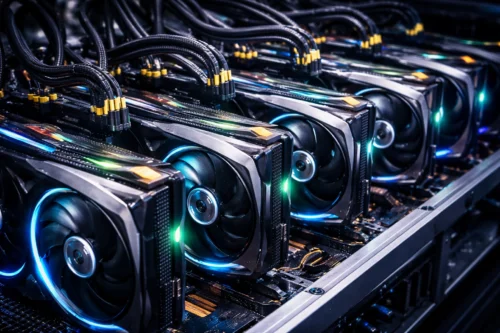
Modern server workloads are not just more complex—they are fundamentally different in how they operate. Many require parallelism and high bandwidth rather than CPU flexibility, making GPUs essential.
AI and Machine Learning
AI and machine learning are major drivers of GPU adoption. Both training and inference rely heavily on linear algebra operations, which scale efficiently on GPUs.
Common use cases include:
- Training and fine-tuning models (including large language models and computer vision systems)
- High-throughput inference with strict latency requirements
- Real-time recommendation systems
Running these workloads on CPUs alone leads to long processing times or high infrastructure costs. GPUs can reduce training time from weeks to hours and ensure consistent performance in production.
High-Performance Computing (HPC)
HPC was one of the earliest fields to benefit from GPUs. Scientific and engineering applications require processing large datasets with high precision and predictable execution times.
Typical applications include:
- Numerical simulations and modeling
- Research in physics, chemistry, and bioinformatics
- Engineering and financial computations
In modern HPC clusters, GPUs handle most of the computation, while CPUs manage coordination, resulting in dramatic performance improvements.
Data Analytics and Real-Time Processing
Data analytics has shifted from batch processing to real-time insights. Many systems now require immediate responses, especially when handling streaming data.
GPUs help accelerate:
- Large-scale analytical queries
- Real-time data processing
- Complex ETL pipelines
Their high bandwidth and parallelism significantly reduce latency, making them ideal for monitoring systems, fraud detection, and analytics platforms.
Rendering and Visualization
Although GPUs are traditionally associated with graphics, their role in servers extends far beyond that.
Common use cases include:
- Server-side rendering and 3D visualization
- High-resolution video encoding and decoding
- Remote workstations and visualization platforms
These workloads demand consistent performance and high compute density, making GPUs the preferred solution.
Virtualization and Cloud Environments
The growth of cloud computing and virtual desktop infrastructure (VDI) has increased demand for GPUs in shared environments.
In these settings, GPUs are used for:
- Virtual GPU (vGPU) and passthrough configurations
- Accelerating workloads inside virtual machines
- Supporting AI, analytics, and visualization in the cloud
Here, GPUs act as shared resources that improve efficiency and resource utilization.
GPUs in Modern Server Architecture
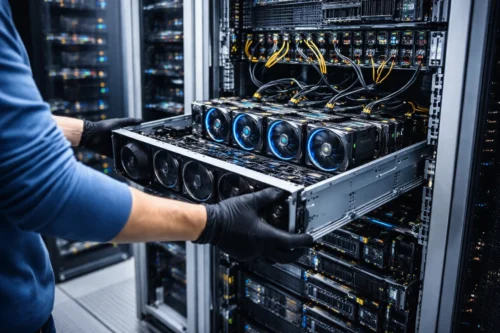
Integrating GPUs into servers changes not just performance, but the entire system design. GPUs are no longer optional add-ons—they are central to modern server architecture.
Integration and Interconnects
How GPUs connect to the system is critical. Bandwidth and latency directly impact performance, especially in multi-GPU setups.
Common connection methods include:
- PCIe for flexibility and scalability
- High-speed links like NVLink for direct GPU-to-GPU communication
The choice of interconnect determines both performance and workload suitability.
Power and Cooling Considerations
GPUs consume significantly more power than traditional server components, increasing demands on data center infrastructure.
This requires careful planning of:
- Power supply and redundancy
- Cooling systems, including air and liquid cooling
Without proper design, GPU-based systems cannot sustain high workloads reliably.
System-Level Balance
GPUs also place demands on other components. High computational throughput requires equally capable networking and storage systems.
If storage or networking becomes a bottleneck, GPU performance is wasted. Modern systems must be designed holistically, balancing compute, memory, storage, and networking.
Operational and Economic Considerations
GPUs are often seen as expensive, but their value depends on how well they match the workload.
For highly parallel and compute-intensive tasks, GPUs significantly reduce execution time. This improves compute density and reduces the number of servers required, lowering costs related to power, space, and operations.
GPUs are most effective when:
- Workloads scale with data size rather than service count
- Low latency and high throughput are critical
- CPUs become a performance bottleneck
Common mistakes include choosing the wrong GPUs, failing to balance system components, or using GPUs where CPUs would be more efficient.
GPUs as a Core Component of Modern Servers
GPUs are no longer niche solutions. They have become essential due to fundamental changes in workload requirements—from AI and analytics to virtualization and visualization.
For modern data centers, GPUs are not just a trend—they are a necessity. They play a key role in ensuring performance, scalability, and efficiency in the next generation of server infrastructure.